Surface Force Apparatus
The SFA is a sensitive technique for measuring the range and magnitude of the molecular forces between two curved surfaces. In this instrument, two surfaces are carefully moved towards and retracted from one another, all the while measuring their interaction force. One surface is held by a cantilevered spring, and the deflection of the spring is used to calculate the force being exerted. This technique uses piezoelectric positioning elements (in addition to conventional motors for coarse adjustments), and senses the distance between the surfaces using optical interferometry. Using these sensitive elements, the device can resolve distances to within 0.3 nanometer, and forces at the 10–8 N level. This extremely sensitive technique can be used to measure electrostatic forces, elusive van der Waals forces, and even hydration or solvation forces. SFA is in some ways similar to using an atomic force microscope to measure interaction between a tip (or molecule adsorbed onto the tip) and a surface. The SFA, however, is more ideally suited to measuring surface-surface interactions, and can measure much longer-range forces more accurately.
In the SFA method two smooth cylindrically curved surfaces whose cylindrical axes are positioned at 90° to each other are made to approach each other in a direction normal to the axes. The distance between the surfaces at the point of closest approach varies between a few micrometers to a few nanometers and down to contact. When the two curved cylinders have the same radius of curvature, R, this so-called 'crossed cylinders' geometry is mathematically equivalent to the interaction between a flat surface and a sphere of radius R. Using the crossed cylinder geometry makes alignment much easier, enables testing of many different surface regions for better statistics, and also enables angle-dependent measurements to be taken. A typical setup involves R = 1 cm. Position measurements are typically made with a white-light source and by analyzing the fringes of equal chromatic order (FECO) (although use of a laser is also possible). The substrate for the surfaces or molecules of interest is generally mica coated with a semi-reflective layer of silver. This optical setup enables determination of the distance between the two surfaces. Mica is used because it is extremely flat, easy to work with, and optically transparent. Any other material or molecule of interest can be coated or adsorbed onto the mica layer.
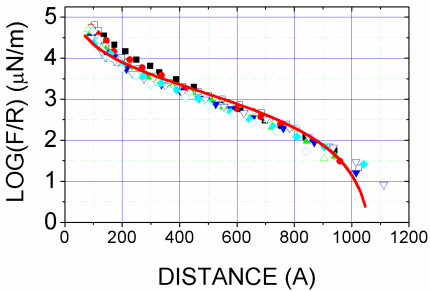
A typical measurement with SFA instrument is shown in the diagram. The mica surfaces bare polystyrene brushes that are formed when incubation for 24 hours in toluene solution has previously taken place.